AI-assisted documentation turns speech or existing records into a draft. In Validi, AI can support notes, treatment plans and reports. The professional checks the information, makes the assessment and approves the text. A fluent draft can still contain errors or leave out important facts.
This guide is for staff and managers in substance use treatment, mental health support and social care. It explains what to try before making AI part of everyday documentation. It is written by Validi about our own approach, rather than as an independent product review.
What can AI help with?
Dictation and drafting from existing records solve different problems. Dictation turns what a member of staff says into writing. A report draft brings information from a period together. Both need review, but they need different checks.
Swipe sideways to compare all columns.
| Task | AI's contribution | What the professional checks |
|---|---|---|
| Dictating a note | Converts speech into text | Names, terminology, numbers and words such as “not” |
| Treatment plan | Suggests a draft from available information | The service user's wishes, goals and agreed actions |
| Progress report | Brings together information about the course of care | Dates, sources, omissions and conclusions |
| Closing report | Suggests a summary of the course of care | Completed work and agreed next steps |
| Care-plan goals | Suggests wording for goals and actions | Relevance and agreement with the service user |
AI cannot decide what is professionally appropriate in an individual situation or make an incomplete record complete. An undocumented point needs clarification; a plausible sentence must not be accepted as a fact simply because it reads well.
Review an AI draft in six steps
- Choose the person, task and period. Check that you are working in the correct record and know what the document is for.
- Review the source material. Check whether relevant notes and agreements are available. Deal with missing information separately.
- Compare the draft with the record. Check dates, attendance, events and descriptions of support. Look for claims that are more definite than their sources.
- Separate facts and assessments. Make it clear what the service user said, what staff observed and what your professional assessment is.
- Edit and approve. Add necessary information and remove inaccurate or irrelevant wording before saving.
- Review the workflow. Agree how staff report recurring problems and how local instructions will be improved.
AI-assisted content in Validi is marked and included in the version history. That makes AI involvement visible; it does not replace professional review.
An example of professional review
Imagine a fictional record describing attendance at two appointments and a missed third appointment. A draft turns this into “attendance is consistent and the service user's wellbeing has improved”. Attendance alone does not support the latter conclusion.
The reviewer should describe attendance accurately, check whether relevant information about wellbeing exists and add their own assessment. If the evidence is incomplete, the uncertainty should remain visible. This example illustrates a review task. It is not a measured AI result or a customer time-saving claim.
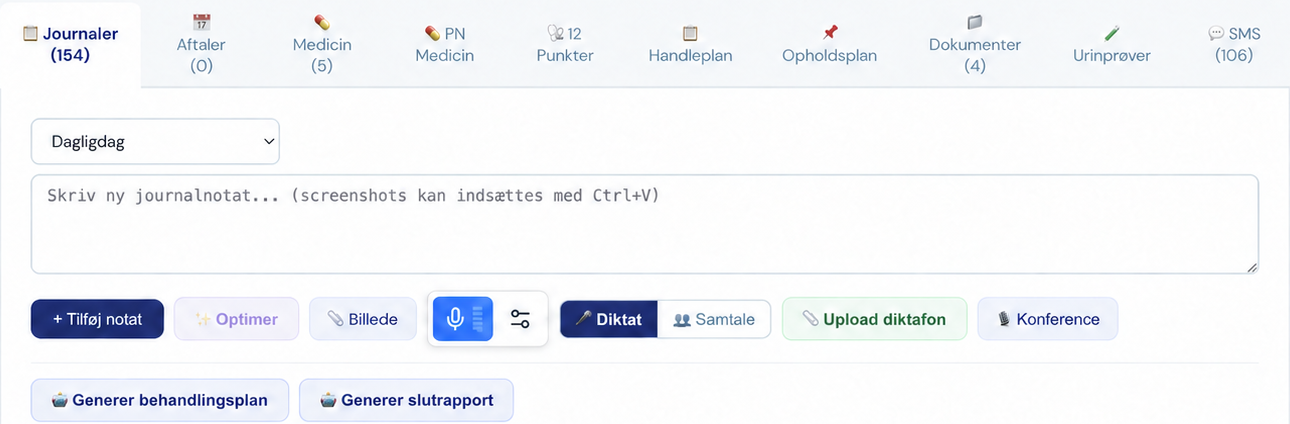
The journal editor in Validi. Click to view the image at full size.
Who is responsible?
The Danish Patient Safety Authority explains that using AI in healthcare does not transfer responsibility away from the healthcare professional. The professional must independently assess whether the AI contribution is appropriate in the particular situation. See its guidance on digital healthcare and professional responsibilities in Danish.
Management must also establish the working procedures. For speech recognition, the authority highlights instructions and procedures for checking the resulting text. See management's responsibility for record keeping.
Social care services should adapt their instructions to staff roles and tasks. Define who writes, who approves and how errors are handled. Healthcare records and social care documentation should not be described as though every legal requirement were identical.
GDPR: clarify data processing before use
Records can contain sensitive personal information. Before using AI with real service-user data, involve the person responsible for data protection. Review the purpose, legal basis, necessary information, access, subprocessors and any transfers outside the EEA. The data processing agreement must reflect actual use.
Ask the provider what information the AI function receives, how long it is retained and whether it is used for other purposes. Integration into a record system is not, by itself, proof that every use is lawful. Use fictional information when trying a public demo.
Articles 5, 9 and 28 of the GDPR cover core principles, special categories of personal data and the controller–processor relationship. The regulation is reproduced in the annex to the Danish Data Protection Act.
How to assess whether it helps your team
Choose a specific task, such as a progress-report draft, and agree what a usable result must contain. Look at omissions, corrections, readability and the total time needed to produce an approved note. Include checking and editing in that time.
Involve both experienced and newer staff. A polished first draft is only useful if the complete workflow works for the people responsible for documentation. We do not claim a particular percentage saving without measured evidence.
Try the workflow in Validi
Create a free demo and explore the features using fictional data. You can also review Validi's features, current pricing and our guide to record systems for substance use treatment. Usage charges for AI services are shown on the pricing page.
Frequently asked questions about AI-assisted documentation
Can AI complete a record without approval?
In the workflow described here, AI produces a suggestion which a professional reviews, edits and approves. AI does not decide the professional assessment. Review must cover both the content present and any important omissions. Task-specific checkpoints are therefore more useful than a general instruction to proofread. The person approving the text needs to understand the underlying case.
How does dictation differ from a report draft?
Dictation converts spoken words into text. A report draft combines existing information into a new document. Dictation needs checks for misheard terms and numbers; summaries also need checks for unsupported connections, conclusions and the correct reporting period. Both require professional review, and a well-written result should never be treated as proof that every detail is correct.
How much time will we save?
That depends on the task, source records and corrections needed. Measure the complete workflow through to approval, including review. Try several representative tasks and record cases where the draft is unusable. Validi does not promise a specific saving based on an imagined scenario; your team should assess the benefit in its own working conditions and compare like-for-like tasks.
Can we try AI without real personal information?
Yes. Start with fictional data in the demo and check whether the workflow makes sense to staff. Let them practise reviewing and editing a draft. A trial involving real records requires a separate review of data processing and the applicable agreements. A public demo and a live environment containing actual records are different situations and must be handled accordingly.