Digital care plan in psychiatry and rehab
30 April 2026

What is a digital care plan, and how is it used in social psychiatry and addiction care? Goals, interventions and follow-up in one journal system.
A digital care plan is a care plan created, maintained and followed up on directly in a journal system. Goals, sub-goals, interventions and follow-up are gathered in one place, so staff can work systematically with the service user's development.
In supported-housing facilities, social psychiatry and addiction treatment, a digital care plan makes it easier to build overview, document progress and follow up continuously — especially where several staff members work around the same service user, and where the plan needs to be an active everyday tool. In Validi, the care plan is linked to journal notes, medication, attendance and other documentation.
What is a digital care plan?
A digital care plan is the electronic version of the plan that describes the service user's goals, the agreed interventions, and how progress is followed up over time.
The purpose is to make the work concrete and useful in practice. The plan should not just describe what you want to achieve, but also how to get there, who is responsible, and how development is assessed.
When the care plan is digital, it becomes easier to:
- gather all information in one place
- update the plan continuously
- follow up on goals and sub-goals
- document changes
- create overview for the entire team
What should a care plan contain?
A care plan needs to be concrete enough to be usable in daily work with the service user. Whether you work in social psychiatry or addiction treatment, a care plan typically contains the same core elements.
Life domains
The care plan can be divided into relevant areas such as housing, finances, health, relationships, employment or substance use. That provides clearer structure and better overview.
Goals and sub-goals
Each area should have concrete goals and sub-goals, so it is clear what is being worked towards. The more precise the goals are, the easier they are to follow up on.
Interventions
It should be clear what interventions have been agreed, and how staff and service user work towards the goals in practice.
Responsibility and follow-up
It should be clear who is responsible for which parts of the work, and who follows up. A care plan is a living document — the plan must be continuously adjustable and evaluable.
Example: Jens
Goal: Jens wants to achieve stability in his alcohol use and improve his mental well-being over the next six months.
Sub-goals:
- Attend group treatment twice a week for three months
- Develop a weekly plan for managing cravings together with his key support worker
- Build social relationships through a network meeting at least once a week
- Stabilise his medication in cooperation with the psychiatrist
Interventions:
- Individual conversations every Monday at 10 am with the key support worker
- Social activities at the supported-housing facility on Thursdays and Saturdays
- Medication follow-up every Friday by health-care staff
- Documented contact with the psychiatrist every fourth week
Responsibility: The key support worker has overall responsibility for follow-up. Health-care staff manage medication. Jens himself is responsible for attendance and self-reporting.
Benefits of a digital care plan in social psychiatry and addiction treatment
Social psychiatry and addiction treatment require close follow-up, coordination and documentation. A care plan only delivers real value when it is used actively and updated continuously — which is hard in paper- and Word-based workflows.
A digital care plan changes the work concretely:
| Before (paper/Word) | With digital care plan |
|---|---|
| Generic goal phrasing | Goals linked to real data |
| Missing continuous follow-up | Follow-up in daily workflow |
| Limited overview of progress | Scoring and visualisation over time |
| Duplicate work across systems | One coherent workflow |
| Unclear ownership and versions | Audit trail on every change |
For many services, it is precisely the integration between the care plan and the rest of the documentation that makes the difference between a plan that gets written and a plan that actually gets used.
Digital care plan with AI
AI can support care-plan work, but professional judgement still rests with the staff member.
In Validi, AI is used as an assistant that can suggest goals and interventions based on the information already in the system.
How AI suggestions work
The AI reads relevant data — journal notes, medication, attendance, urine tests and previous care plans — and suggests phrasings for goals and interventions. The staff member can approve, edit or reject each suggestion.
Example of an AI suggestion
In Validi, the AI suggestions are shown in an editing window where the staff member can accept, adjust or reject each suggestion:
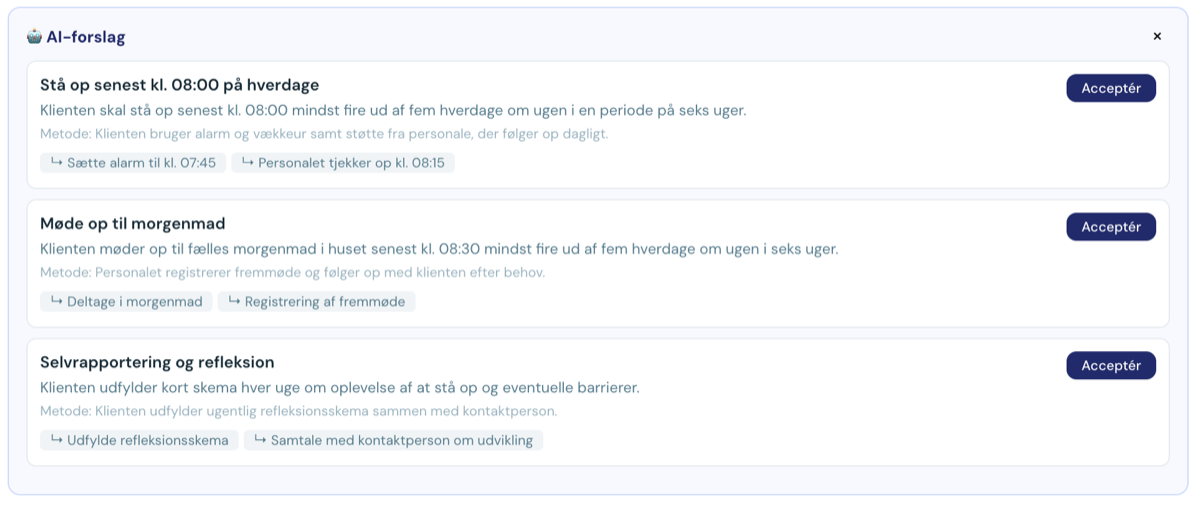
A simplified example of what the AI works from and proposes:
Input: Last 10 journal notes, active medication, attendance over the last 4 weeks, previous care plan with goal status.
AI suggestion for goal:
"Service user is working on reducing alcohol use and has shown increased stability over the last 3 weeks. Proposed goal: Maintain current abstinence for at least 30 days, supported by weekly follow-up sessions and NA meetings."
AI suggestions for sub-goals:
- Attend at least one NA meeting per week for 4 weeks
- Document cravings and coping with the key support worker weekly
- Rate sleep quality on a 1-10 scale twice a week
The staff member can approve directly, adjust the wording, reject and write their own, or request a new suggestion with a specific angle — for example "focus on employment".
How do you follow up on a care plan digitally?
Follow-up becomes part of the daily workflow instead of being tied to specific meetings. Staff can record changes, adjust goals and assess progress directly in the system.
Progress scoring
For each sub-goal, the staff member can assign a score from 1 to 5, where 1 is "no progress" and 5 is "goal achieved". The score is filled in at follow-up meetings or on an ongoing basis.
| Sub-goal | January | February | March | April |
|---|---|---|---|---|
| Attend group treatment 2x/week | 2 | 3 | 4 | 4 |
| Weekly plan for craving management | 1 | 2 | 3 | 4 |
| Social relationships via network mtg. | 1 | 1 | 2 | 3 |
| Stabilised medication | 3 | 4 | 4 | 5 |
The history makes it clear where development is happening and where extra attention is needed. At follow-up meetings, it serves as a discussion basis — scoring does not replace professional judgement, but makes it easier to talk concretely about development.
Audit history and documentation
Every change is logged with timestamp, staff member and which fields were edited. That makes it possible to:
- go back to previous versions of the plan
- see precisely when a goal was adjusted — and by whom
- document the basis for decisions during inspections and audits
- export the plan's history to PDF or CSV when needed
Are digital care plans GDPR-safe?
Care plans in social psychiatry and addiction treatment often contain sensitive personal data. Data security and traceability are therefore critical.
A digital care plan should be handled in a system where:
- access can be controlled
- changes are logged
- data is stored securely
- export and extracts can be handled correctly
- there is a clear audit trail
In Validi, sensitive personal data is encrypted, and there is traceability on who has opened, edited or exported a care plan.
How to create a care plan in Validi
In Validi, you can create a care plan directly from the service user's profile. Choose life domains and decide whether to start from scratch, use a template, or build on AI suggestions.
Many care plans follow recurring patterns — dual diagnosis, withdrawal management, employment, or stabilising daily life. With templates, staff can start from a shared structure instead of beginning from scratch every time. Teams can save their own templates in Validi.
The typical workflow:
- choose relevant domains
- create goals and sub-goals — from scratch, template or AI suggestion
- add interventions and responsibilities
- edit and adapt
- save and send for approval
- follow up continuously in the system
Frequently asked questions about digital care plans
What are the benefits of a digital care plan?
Better overview, easier follow-up, less duplicate work, better traceability, and more coherence between the care plan and the rest of the documentation — instead of sitting as a separate document that rarely gets opened.
How are care plans used in social psychiatry and addiction treatment?
To structure the work on the service user's goals and interventions across areas such as housing, health, relationships, employment, substance use and everyday coping. The content follows the same logic across the two fields, but with different weighting of domains.
Can AI help with care plans?
Yes — AI can suggest goals and interventions based on existing documentation. Professional judgement always rests with the staff member, who edits, approves or rejects the suggestions.
Can a digital care plan be exported?
Yes. The care plan can typically be exported as PDF or included in data extracts and documentation.
Want to see how Validi gathers goals, interventions and follow-up in one system? Book a demo and we'll walk you through a digital care plan in practice.
Was this post helpful?