When a colleague takes over a service user's support, the records should answer a few straightforward questions: What are we working towards? What have we done? How does the service user experience the support? And what happens next?
These questions also help when preparing for a Danish social services inspection. This guide suggests a routine for reviewing documentation throughout the year. It is not a ranking of the most common enforcement findings, and no particular form guarantees approval. Adapt the routine to your service users, your approval conditions and your most recent inspection report.
Sources and professional references reviewed on 10 September 2026.
Use the current quality model
The Danish social services inspectorates' 2026 quality model for services has five themes:
- Target group, methods and results
- Health and well-being
- Organisation and management
- Staff competencies
- Physical environment
Financial matters also form part of the quality assessment, but sit outside the model itself. See the inspectorates' current explanation. Older guidance listing seven themes should therefore not be your only reference.
Records contribute to the evidence, but cannot describe every aspect of a service's quality. Include service users' perspectives, staff experience and management follow-up when reviewing practice. The 2026 quality model provides the common assessment framework.
Inspection activity is informed by risk. The shared risk model explains how concerns about quality affect inspection activity. A regular documentation routine is more useful than waiting for notice of a visit.
Distinguish social care records from healthcare documentation
A social care service may also carry out healthcare tasks. These bring requirements overseen by the Danish Patient Safety Authority, for example in medication handling and nursing. The authority explains this in its guidance on inspections of residential services.
Make responsibilities explicit. Who follows up on social care goals? Who records a healthcare task? Who acts when a concern arises? A shared record system can bring the information together, but staff still need to understand the responsibilities and requirements that apply to their work.
Five areas to review
1. The connection between goals, support and follow-up
Choose a specific goal and trace it through the record. Can a colleague identify the support that was agreed, what actually happened and what the team learned? Are the service user's wishes and responses included where relevant?
Consider a fictional example: a service user wants to join a group activity, and you agree to support them in attending. The review should cover more than whether the activity was offered. Record whether they attended, how they experienced it and whether the support needs to change. A decision not to continue is relevant information too.
A useful routine: Agree who will review the goal, when the review will happen and where the decision will be recorded. Choose the interval to suit the support plan and the individual agreement. Finish by identifying the next action and the person responsible for it.
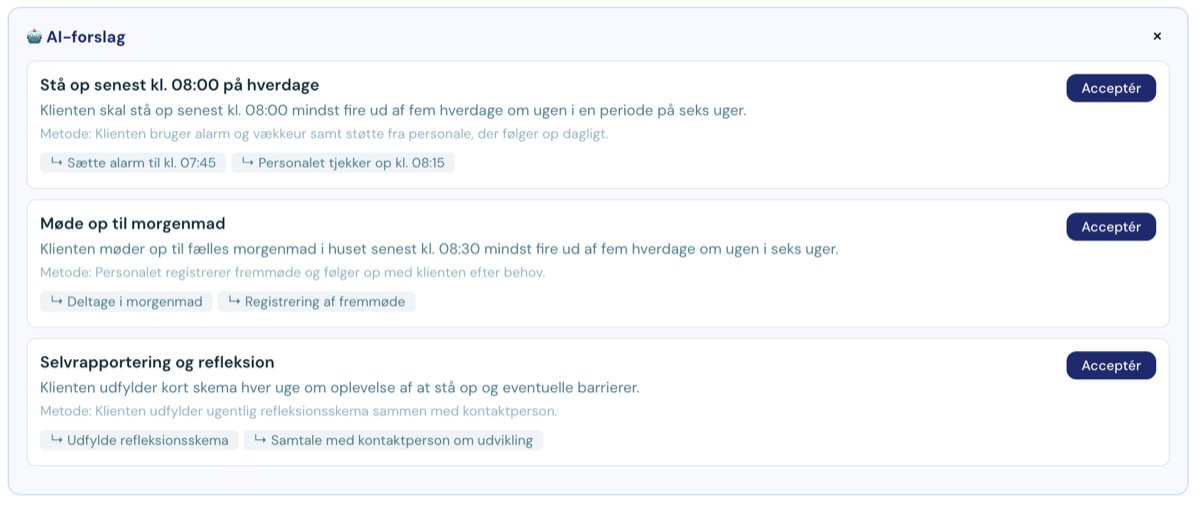
AI suggestions for care plan sub-goals and interventions in Validi for professional review, shown in Danish. Select the image to view the full-size detail.
2. Relevant healthcare documentation
For nursing tasks, staff must consider the twelve nursing problem areas and record relevant information. This does not mean filling every field with standard text about matters that have no bearing on care. See the Danish Patient Safety Authority's nursing documentation guidance.
Review whether current problems, risks and follow-up are described as needed. An automatically completed field cannot replace professional judgement. A score alone should not be the only explanation of what staff need to do.
Validi supports this work with AI drafts for the nursing problem areas. The AI decides nothing: the professional reviews, changes and approves.
3. Notes another colleague can act on
Distinguish observations, the service user's own account and your professional assessment. They can appear in the same note, provided the reader can tell them apart.
Compare "the service user had a difficult day" with: "The service user did not attend the agreed meeting and subsequently said that they had had a restless night. We arranged another meeting and informed the responsible colleague." The second example gives the next colleague something concrete to work with, without assigning a cause that has not been explored.
Danish guidance no. 10239 of 1 December 2025 says nursing records should be made during or soon after patient contact. Where an exceptional delay is necessary, they must be made before working hours end; the guidance also addresses technical limitations. Later additions must be identifiable as such. Healthcare record-keeping rules should not be presented without qualification as identical requirements for every social care note.
4. Incidents and subsequent learning
Distinguish the entry in the service user's record, internal follow-up and a statutory report. These are separate tasks even when they concern the same incident.
Use of force must be handled under the rules and reporting forms applicable to the intervention and the relevant service user group. The Danish Authority of Social Services and Housing provides adult-sector forms and guidance. These should not automatically be treated as the rules for children's services.
Adverse healthcare incidents have a separate reporting system. There are, for example, specific arrangements for aggregate reporting of selected incidents. Local procedures should identify the applicable deadlines and reporting routes, rather than inventing a single rule that everything must always be reported on the same day.
Review a completed case: Was the necessary follow-up agreed? Does the responsible person know what must change? Can staff find the revised procedure? The review should turn experience into action, as well as establish what was recorded.
5. Access and the basis for sharing information
Identify who needs which information for their work. Pay particular attention to role changes, temporary staff and departures. Assign responsibility for updating access so that the task does not depend on someone happening to notice an old login.
Consent is not the only possible legal basis for processing or disclosing personal data. The appropriate basis depends on the circumstances. Where consent is used, you must be able to demonstrate its content and scope. Consent may be oral, written or digital; a paper record is not inherently inadequate. See the Danish Data Protection Agency's consent guidance.
Step by step: a regular documentation review
The following is a suggested working routine, not a new set of statutory requirements:
- Start with the latest inspection report. List relevant points, the responsible person and where follow-up is documented.
- Select a manageable number of records. Include both a stable support arrangement and one where the approach has changed. Avoid choosing only the best-documented examples.
- Trace a goal from agreement to review. Check that the service user's perspective and the next action are clear.
- Check relevant healthcare content. Involve a colleague with the competencies needed to review this area.
- Agree how to address gaps. Separate issues requiring action now from routines that need improvement. Later additions must not appear to have been written earlier.
- Follow up on the agreements. Set a date for the next review and check whether staff are using the revised routine.
Ask a colleague unfamiliar with the case to find the next agreed action. If this requires explanations from several members of staff, you have found a specific opportunity to improve the records.
For each improvement, record what is changing and how you will know whether it helps. For example, a revised care-plan template should make the responsible person and review date easier to find. Try it on an actual workflow before rolling it out across the team. More mandatory fields are not necessarily the right answer; sometimes clearer instructions or a better handover are more useful.
Data protection during review and disclosure
Use information that is necessary for the purpose, and assess the basis and scope of any disclosure. A combined folder containing other service users' information should not be included merely for convenience. The Danish Data Protection Agency explains the relationship between accountability and data minimisation.
Agree a secure transfer method, a responsible person and a check of the intended recipient. Keep identifiable working notes in approved systems. Retention and deletion must follow the rules applicable to the material; a general clean-up routine must not remove records that must be retained.
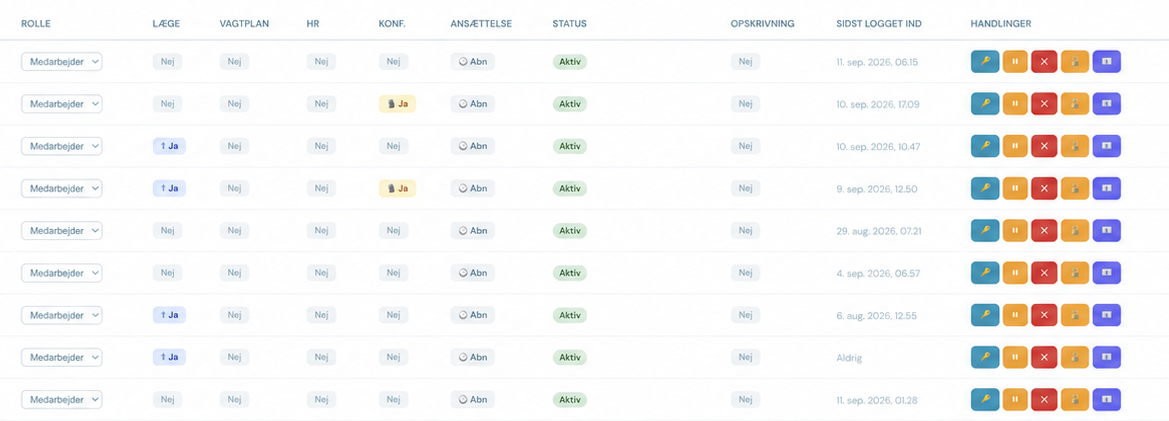
Staff roles, permissions and account status in Validi, shown in Danish. Select the image to view the full-size detail.
How Validi can support the work
Validi brings case notes, care plans and follow-up together. AI can assist with drafts based on existing record material. The professional checks the sources, changes the content and approves it. AI-assisted content is marked and forms part of the version history. This describes the workflow; it is not a promise of automatic compliance with every inspection requirement.
Explore records for supported housing and residential care, or book a demonstration using fictional data. An anonymised example of your intended workflow can provide a useful starting point for the discussion.
Frequently asked questions about inspection and documentation
Are well-completed records enough for a good inspection?
No. Records can make goals, support and follow-up clear, but quality must also be present in practice. Use the review to explore whether the documented approach matches the work being delivered. Include service users' perspectives and staff experience. A template can help structure information, but it cannot determine whether a service provides the quality that is required.
Must all twelve nursing fields be completed?
The priority is to consider the problem areas and document what is relevant. Do not confuse a large number of completed fields with a useful professional account. Local templates should help staff describe current problems, risks and planned follow-up. If there is uncertainty about an individual case, the responsible healthcare professional should establish what information is necessary under the current guidance.
What should we do if a note is missing?
First establish whether the gap also means that a necessary action or follow-up was missed. Supplement the record in line with the applicable rules and your procedures. Make clear what is known, where the information comes from and when the addition was written. Do not fill a gap with a confident account of something nobody can now recall. Also review how to prevent a similar gap.
Can an order be issued without enhanced supervision?
Yes. The inspectorates' current explanation distinguishes orders, enhanced supervision, enhanced supervision with orders and withdrawal of approval. Read the actual decision in its own context. If your service receives a decision, the responsible management team should review its requirements, reasons, deadlines and appeal guidance. A general blog guide cannot replace the assessment or advice needed for your particular case.